ENT Department – Prevalence : Obstructive Sleep Apnea 💤 😴 and Vocal Impairment
Automation : Keywords Search

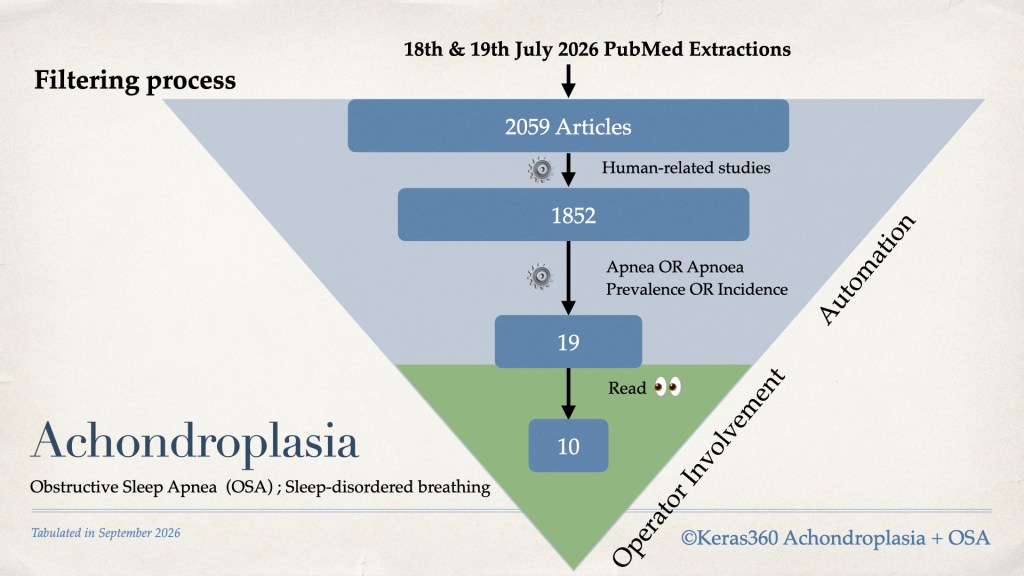
On the 18th and 19th of July 2026, we conducted the initial layer filtering process by obtaining two distinct PubMed extractions for scientific articles related to Achondroplasia; specifically, Achondroplasia AND Apnea. Our automated mining strategy prioritizes human studies, yielding a total of 1,852 unique second-layer isolated articles. In the subsequent automated third layer, we further excluded articles lacking information on apnea (in both British and American spelling), as well as prevalence or incidence data. By the fourth layer, 18 articles + 1 (non-english language article) remained, necessitating a manual review to check for conditions associated with apnea in patients with Achondroplasia. Ultimately, we identified 10 articles that contain critical information pertinent to our objective.
Kindly refer to the accompanying PDF for additional information. Manual searches were conducted on 7th September 2026, and it was determined that no further corrections to the final count were necessary.
Breath Pauses : Stop and Start
Obstructive sleep apnea (OSA) is estimated to occur in no more than 5% of the general population; however, this figure is likely an understatement, as many individuals remain undiagnosed throughout their lives. Nocturnal snoring is one of the prevalent symptoms, and long-term OSA can lead to cardiovascular complications that may be erroneously attributed to aging. Furthermore, a subset of individuals tends to exhibit pronounced sleep-related breathing disorders. For instance, children with achondroplasia (AD), who are affected by skeletal dysplasia due to the FGFR3 gene mutation, experience a risk for OSA that is at least tenfold greater, with a reported occurrence of at least 50% among those diagnosed with AD. Since the 1990s, a notable increase in OSA diagnoses among children with AD has been observed, which may be attributed to improved recognition of Foramen Magnum Stenosis (FMS) through MRI scans and the establishment of standardized clinical guidelines for surgical intervention when FMS scores exceed a specific threshold.
Other lesser-known and rare diseases that may contribute to the development of obstructive sleep apnea (OSA) include Prader-Willi syndrome, Ehlers-Danlos syndrome, Pierre-Robin sequence, sickle cell disease, mucopolysaccharidosis, osteogenesis imperfecta, Ellis-van Creveld syndrome, and Noonan syndrome.
Treatment options: Continuous Positive Airway Pressure therapy (CPAP) or surgical intervention such as adenotonsillectomy.
Vocal impairment, vocal injuries 🎤
Vocal impairment represents a significantly underrecognized occupational health hazard, particularly within the domains of construction workers and professional singers. More commonly reported vocal injuries encompass dysphonia, especially among children who have undergone prolonged periods in the neonatal intensive care unit (NICU) involving intubation, which results in vocal irritation and trauma. A systematic literature review search conducted by Keras360 yielded a total of 1,401 articles for “Vocal Cord”, “Vocal Injury” : 1,327 in English, 50 in Chinese, and 27 in other languages, with an extraction date of August 2, 2026. Among the 1,394 human-relevant articles, only 8 pertained specifically to children and dysphonia, while the domain of vocal injuries and interventions related to singers was represented by 14 scientific articles.
Treatment options: Voice therapy, surgical intervention such as microlaryngeal surgery.
© Keras360, 水の家: The novel automated protocol for conducting a modern systematic literature review (SLR) search was established in the years 2022 and 2023 by 水の家. For further information, please reference ‘Modern SLR’ in your correspondence directed to contact.general@keras360.io.